
Tel: +86 13962653966 | Email: sales@szeasychem.com
Tel: +86 13962653966 | Email: sales@szeasychem.com
| Appearance | Colorless or light yellow transparent liquid |
| pH value | 4.5-6.5 |
| Specific gravity, g/ml | 1.045-1.055 |
| Flash point | Does not glow when boiling |
| Good stability in the range of pH (1-11) and stability | |
| active dispersion in water compatible with water in any ratio | |
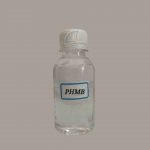
Polyhexamethylene biguanide compound disinfectant is a new type of detoxifier, the main component is polyhexamethylene hydrochloride
Biguanide, methylguanidine in polyhexamethylene biguanide hydrochloride has high activity and is easily absorbed by bacteria and viruses
Attached, acts on the cell wall system and/or cell membrane system of bacteria, fungi, algae, and combines with cellular phospholipids
The combination of substances rapidly breaks down their membrane system, allowing the efflux of intracellular substances and inhibiting some attachment to cells.
The enzymatic activity of the membrane, thereby inhibiting the division function of bacteria and viruses, so that bacteria and viruses lose their ability to reproduce, and
And the formation of the polymer blocks the respiratory passages of microorganisms, so that the microorganisms suffocate and die, so as to achieve antibacterial,
Anti-mildew effect. At the same time, its high molecular polymer structure improves the effective activity of the guanidine group, making its bactericidal effect.
The force is much higher than other guanidines, and bacteria are not easy to develop drug resistance. Polyhexamethylene biguanide broad-spectrum antibacterial
Gram-positive bacteria, Gram-negative bacteria, fungi and yeast have the ability to kill.
Polyhexamethylene biguanide can be used for a long time with very low toxicity.
Skin irritation test, mouse bone marrow polychromatic erythrocyte micronucleus test, mouse sperm deformity test, cumulative toxicity test
A series of toxicity tests such as test, skin allergy test, etc. The test results show that:
①Acute oral toxicity test
After the mice were poisoned, there were no symptoms of poisoning and no death. The oral LD50 of male and female mice was greater than 5000 mg/kg body weight, PHMB
It is an actual non-toxic grade.
② Rabbit skin irritation test
The mean value of PHMB’s response to skin irritation is 0, indicating that the disinfectant is actually non-irritating to rabbit skin.
③Micronucleus test
There was no significant difference in the ratio of micronucleated cells and PCE/NCE between the experimental group and the negative control group, but compared with the positive control group.
There is a significant difference between groups (p<0.01), indicating that the disinfectant does not cause micronucleus to the bone marrow polychromatic cells of mice
effect.
④ Mouse sperm deformity test
The high, medium and low dose groups of the disinfectant had aberration rates of mouse sperm cells of 1.68, 1.77, and 1.90, respectively.
The aberration rate of the negative control group was 1.88, and there was no significant difference in the sperm cell aberration rate between the experimental groups and the negative control group.
Significant (p<0.05); positive control aberration rate was 9.80, sperm cell aberration rate of each experimental group was the same as that of positive control
There was a significant difference in group ratio (p<0.01). The disinfectant has no teratogenic effect on the sperm of male mice.
⑤ Accumulation toxicity test
After 20 days of administration, the mice did not die, and the accumulation coefficient k>5, according to the classification standard of accumulation toxicity [2],
PHMB disinfectant has weak cumulative toxicity.
⑥Skin allergy test
The sensitization rate of guinea pigs in the test group was 0%, and no skin allergies were found, indicating that the disinfectant had no sensitization effect.
Compared with traditional skin disinfectants, polyhexamethylene biguanide compound disinfectant has low effective concentration and good stability.
And non-toxic, non-stimulating, no mutagenic effect, no micronucleus effect, no teratogenic effect on male mouse sperm.
A weak accumulation of toxicity, does not cause allergic reactions.
①Europe
PHMB passed BPD (Bactericide Product Directive)
PT01 (Bactericidal Products for Personal Hygiene)
PT02 (Disinfection of private and public places)
PT03 (Veterinary Hygiene Sterilization Products)
PT04 (Disinfection in the Food and Catering Field)
PT05 (Drinking water disinfection)
PT06 (in-tank anticorrosion)
PT09 (preservation of fibres, leather, rubber and polymeric materials)
PT11 (Corrosion Protection of Liquid Cooling and Handling Systems)
PT12 (Slimicide)
PT22 (liquid system anticorrosion)
PGMB in the European cosmetic directive 76/768/EEC can be used for the preservative of cosmetic products, up to
1.5%.
②North America
☆Can be used on surfaces in contact with food, rinse with potable water after use.
☆As a preservative – used in household consumer products to protect liquid, solid and thick consumer products as shown in the table
Face cleaners, floor cleaners, fabric stain removers, silicone emulsions for car care, fabric finishes, washing
Laundry cleaners and additives for odor and microbial control in cotton products and synthetic fibers
☆ Listed in CTFA (Cosmetics, Fragrance Association) as a cosmetic preservative
China
☆PHMB is registered in the Chemical Registration Center of the State Environmental Protection Administration—Included in the “Name of Existing Chemical Substances in China”
Record”CAS-No.27083-27-8
☆PHMB is included in the new national standard “General Requirements for Guanidine Disinfectants”—suitable for surgical hand disinfection, hygiene
Hand disinfection, preoperative skin and mucous membranes and clinical skin and mucous membranes, cleaning and disinfection, and surface disinfection.
☆PHMB is listed in the 07th edition of the “Hygienic Standards for Cosmetics” of the Ministry of Health of China
Efficient —- only a small amount of addition can show excellent antibacterial, antifungal, and algae killing effects, average
The kill rate is 99.99%;
Safety—-no toxic and side effects, no irritation to skin, mucous membranes and eyes, and no skin allergy to it;
Environmentally friendly—-colorless, odorless, non-volatile, free of heavy metals, halogens, phenols, aldehydes,
All kinds of surface treatment without corrosion;
products, skin care products, antibacterial hand sanitizer, antibacterial laundry detergent, shower gel, disposable wet towels; floor mopping wipes, Car and furniture cleaning wipes, etc.

About Us
Easychem – a manufacturer of Suzhou Easy Chemical is a professional preservative manufacturer and chemical ingredients supplier, offering for wide range of industries to global market.
Strategic partner:
Defoamer manufacturer-Invelychem
Contact
 Suzhou Easy Chemical Co. Ltd
 Contact: Joyce Yu
 Email: sales@szeasychem.com
 Tel: +86 13962653966
 WhatsApp: +86 13962653966
 WeChat: +86 13962653966
We will contact you within 2 hours, please pay attention to the email with the suffix “joyceyu@szeasychem.com”.